Solar Fleet
The Dark ForestThe Solar Fleet is the space-based political and military order that emerges when the old nation-states lose their dominant position. Formed from the Asian Fleet, European Fleet, and North American Fleet, it possesses the power of superstates while remaining formally separate from terrestrial government. Its creation transforms humanity’s defense effort from an international program into a new sphere of power whose decisions determine the fate of the Solar System.
Formation and Political Structure
The Solar Fleet rises during the long development of the human response to the Trisolaran Crisis. The completion of the space elevator and the breakthrough in controlled fusion make large-scale space activity possible, but they do not complete the defense system; leaders recognize that weapons, life-support ecosystems, spaceports, and spacecraft construction still represent a technological frontier that may take a century merely to establish. The fleet therefore grows out of an enormous civilizational mobilization rather than a single founding act.
By the era of Luo Ji’s return, the old great powers have disappeared as the principal centers of political authority. The three major fleets are independent political and economic entities, each possessing the strength of a superpower from the earlier age. Their names preserve their regions of origin, but they are no longer subordinate to those regions. Together they constitute the Solar Fleet, while the former Planetary Defense Council becomes the Solar Fleet Joint Conference, nominally its highest command body.
This arrangement divides humanity into two international spheres: Earth International and Fleet International. The Solar Fleet’s territory and sovereignty lie in space, and its charter restricts interference in the internal affairs of terrestrial society. Yet the formal coordinating role of the Solar Fleet Joint Conference conceals the real distribution of power. Like the United Nations, the conference has little direct authority; effective control belongs to the supreme commands of the three major fleets. The organization is thus unified in name and strategic purpose, but politically decentralized at its core.
Strategic Purpose and Technological Choices
The Solar Fleet exists to prepare humanity for a war against the Trisolaran Fleet, but its choices are shaped by severe informational asymmetry. The sophons make Earth transparent to the enemy: meetings, files, computer systems, plans, deployments, and communications can all be observed as soon as they take form. The Wallfacer Project is created precisely because ordinary strategy cannot survive such total exposure. The Solar Fleet inherits this world in which technological development must be paired with concealment, deception, and independent lines of planning.
Controlled fusion produces a major institutional conflict over the future of spacecraft. The aerospace faction favors media-propelled spacecraft, while the space force advocates non-media radiation-drive spacecraft. The former appears safer because it is essentially a fusion-powered variant of the chemical rocket, but it consumes roughly two-thirds of a ship’s carrying capacity in propulsion media and depends on planetary bases for movement through the Solar System. The radiation drive is considered the only route compatible with interstellar voyages, yet choosing it would direct immense resources toward a difficult and uncertain technological peak.
The leadership’s decision is also influenced by the Trisolarans’ limitations. Because the Trisolarans communicate through direct, open thoughts, they are described as deficient in tricks, camouflage, and deception, giving human civilization an advantage that must not be surrendered. The fleet’s strategic culture therefore values not only propulsion and weapons but also hidden intentions, compartmentalized planning, and the ability to act outside the enemy’s immediate understanding.
Expansion and Fleet Mobilization
Humanity’s first planetary expeditions after the space elevator are explicitly military in purpose. Landings on Mars and the moons of Jupiter establish bases for the defense of the Solar System, while later attention turns toward Venus and Mercury because strategic planning reveals that the inner planets cannot be neglected. The Solar Fleet’s emergence is therefore inseparable from the conversion of the Solar System into a defensive theater, in which planets, moons, and orbital routes become parts of a single military geography.
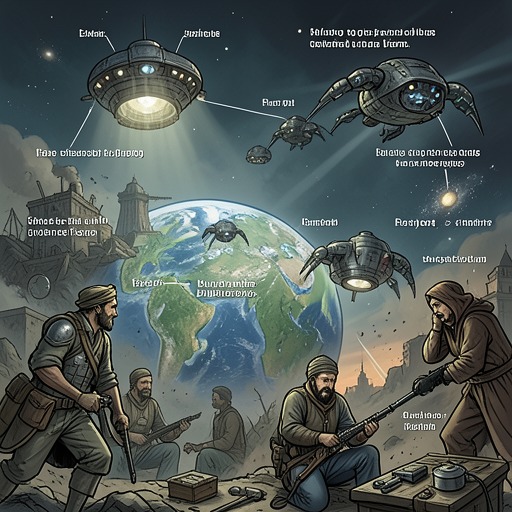
The fleet’s scale becomes visible when the three regional forces are combined into a single force of 2,015 ships to intercept the Trisolaran probe near Neptune. The announcement produces both celebration and mockery: the public welcomes the prospect of a united defense, while some regard the mobilization of thousands of warships against one small probe as excessive. The contrast shows the distance between popular confidence and the strategic uncertainty faced by fleet commanders.
That confidence collapses when the probe destroys the combined human fleet. The initial encounter with the probe appears, for a moment, to involve a possible messenger of peace. The expedition ship Mantis approaches, but its four-person team is vaporized by extreme heat. The ship melts and explodes, and the fleet initially concludes that the probe has self-destructed. Only later does surveillance reveal that one fragment is accelerating: the explosion destroyed Mantis and its crew, but not the probe. The Solar Fleet’s first direct engagement therefore becomes a revelation of overwhelming technological asymmetry rather than a conventional battle.
Command, Security, and Internal Risk
The fleet’s organization becomes especially vulnerable through its command systems. Older vessels use distributed command, in which a captain’s orders are carried out by operating personnel. Newer and more advanced vessels use centralized command, in which the ship’s computer executes the captain’s orders automatically. In these ships, the vessel becomes an extension of its captain’s body: one officer can determine when it leaves or returns to port, its speed and course, and much of its weapon deployment.
This structure makes the newly developed mental seal a direct strategic threat. The technology can bypass conscious calculation and cause a brain to accept information as genuine, allowing an externally introduced judgment to be produced without ordinary reasoning. Because a sealed captain could exercise enormous unilateral control over a centralized warship, the fleet identifies the commanders of such vessels for review. Of the 695 stellar-class warships, 179 have centralized command systems.
The review cannot be conducted under secure dockside conditions because the fleet is preparing to intercept the Trisolaran probe. Every ship must remain on standby for the first actual engagement between the space forces and the invader. The resulting dilemma is characteristic of the Solar Fleet: the very emergency that makes internal security necessary also prevents the organization from carrying out that security safely. Command authority must be transferred to reliable individuals while the fleet remains deployed, turning institutional trust into a matter of immediate survival.
Development, Defeat, and Historical Significance
The Solar Fleet’s development is presented as both humanity’s greatest collective achievement and an incomplete experiment in political adaptation. Its construction promises protection, mobility, and technological advancement, but consumes resources on a scale that threatens to push quality of life backward by a century. The organization is therefore sustained by a difficult bargain: terrestrial society must accept sacrifice in the present for a defense system whose foundations may require generations and whose first major test ends in annihilation.
After the destruction of the combined fleet, the political meaning of space changes again. Escapism, suppressed for two centuries, rapidly returns. The European Commonwealth proposes selecting 100,000 people for departure by nationwide drawing, but the result produces anger and widespread rioting among those not chosen. The surviving warships then enter the Battle of Darkness, and their separation from Earth is interpreted as producing total spiritual alienation. The possibility of a fleet-based civilization without Earth is no longer imagined simply as survival; it is associated with Negacivilization, a post-human enemy of human civilization.
The Solar Fleet thus stands between two contradictory futures. It is the suprastate intended to preserve humanity against an external civilization, yet its autonomous political structure and military concentration create the conditions for separation from Earth. Its history moves from federation to independence, from confidence to exposure, and from the promise of coordinated defense to the danger that those who escape or command in space may cease to belong to the civilization they were formed to protect.